Two Cheers for Politics by Jedediah Purdy
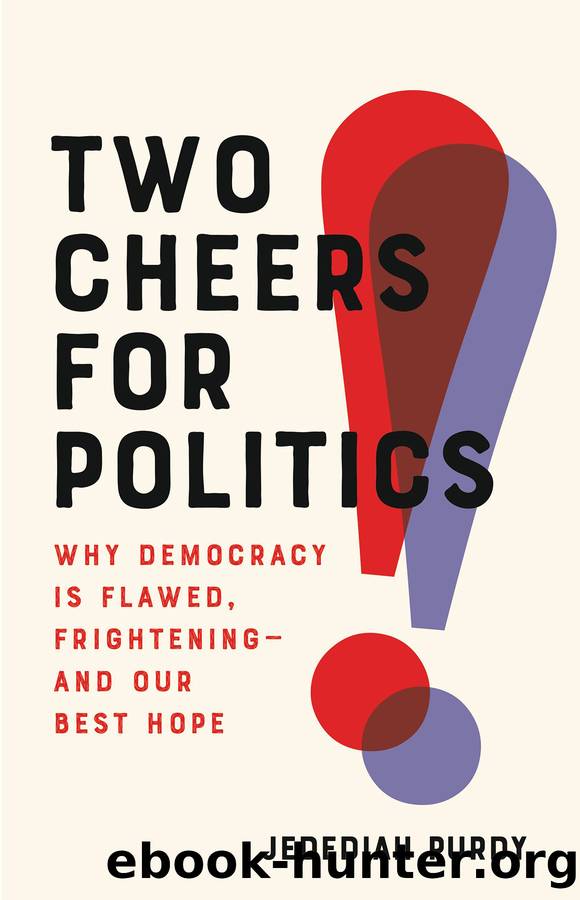
Author:Jedediah Purdy [Purdy, Jedediah]
Language: eng
Format: epub
Publisher: Basic Books
Published: 2022-08-30T00:00:00+00:00
7
DEMOCRACY AND/OR CAPITALISM
In 2020, the gamified day-trading app Robinhood announced that its mission was âto democratize finance for all.â âDemocratize,â in this case, meant opening the doors to a stock-market casino. Six years earlier, promoters were talking about crypto-trading as âdemocratizing Wall Street.â Cryptocurrency Bitcoin âseeks to democratize currency and payments.â In 2011, the résumé-matching site Monster promised to âdemocratize recruitingâ by letting more kinds of job seekers link up with employers. Start looking, and you will see it everywhere: promises to âdemocratizeâ advertising, design, direct marketing, medicine, whatever. Some of these barrier-lowering changes do increase usersâ powers in real ways. Many just intensify the vulnerability of life in the marketplace, speeding up the already relentless press of speculative bets, pushy ads, and precarious jobs, dressed up to make market vulnerability look like freedomâs fun new frontier.1
It isnât surprising that touts would debauch a charismatic word. In twenty-first-century America, whatever you care about will be used to try to sell you something. But marketers werenât leading the charge to change the meaning of democracy. In 2010, the Arbuckle Professor at Harvard Business School explained in the Harvard Business Review that Apple cofounder Steve Jobs âset out to democratize computingâ by making it âavailable conveniently to the masses.â In the same year, Robert Zoellick, then the president of the World Bank and previously George W. Bushâs trade ambassador, promised to democratize development economics by providing open access to the bankâs databases, which included loan records and analyses of economic policies throughout the developing world. Already in 2009, the New York Times was referring to Robinhoodâs precursors as âdemocratiz[ing] investment,â and in 2007 the Times explained the trend of âdemocratizing plastic surgery,â which meant that people with household incomes under $30,000, who often lacked health insurance, were financing their cosmetic procedures with loans. After all, the paper of record pointed out, earning power follows attractiveness. âI financed my car,â the Times reported one patient saying in an emblematic reflection. âWhy shouldnât I finance my face?â2
These are not random abuses of a word. The professional explainers, like the professional marketers, are using democracy in a way that, when you link the points on the scatter plot, adds up to âuniversal market participation plus some transparency.â Itâs no surprise that Silicon Valley icon Steve Jobs pops up here, along with the Apple empire that he helped to build. The meaning of democracy that these uses trace is basically the one that the internet optimists of the 1990s and early 2000s popularized: universal access and transparency would democratize software (through open, unencrypted code), democratize knowledge (through sites such as Wikipedia, which, it became briefly fashionable to say, was better than Encyclopaedia Britannica), democratize the news through blogs and amateur reporting, and democratize democracy itself by enabling citizens to organize online. We now know (and there were warnings at the time, if eyes were open) that actual results would include the largest monopolies in world history, a vile bloom of conspiracy theories and other âalternativeâ knowledge, and an online Hobbesian dystopia of warring multitudes.
Download
This site does not store any files on its server. We only index and link to content provided by other sites. Please contact the content providers to delete copyright contents if any and email us, we'll remove relevant links or contents immediately.
The Secret History by Donna Tartt(19103)
The Social Justice Warrior Handbook by Lisa De Pasquale(12197)
Thirteen Reasons Why by Jay Asher(8919)
This Is How You Lose Her by Junot Diaz(6894)
Weapons of Math Destruction by Cathy O'Neil(6284)
Zero to One by Peter Thiel(5808)
Beartown by Fredrik Backman(5767)
The Myth of the Strong Leader by Archie Brown(5513)
The Fire Next Time by James Baldwin(5454)
How Democracies Die by Steven Levitsky & Daniel Ziblatt(5225)
Promise Me, Dad by Joe Biden(5157)
Stone's Rules by Roger Stone(5091)
A Higher Loyalty: Truth, Lies, and Leadership by James Comey(4967)
100 Deadly Skills by Clint Emerson(4932)
Rise and Kill First by Ronen Bergman(4797)
Secrecy World by Jake Bernstein(4756)
The David Icke Guide to the Global Conspiracy (and how to end it) by David Icke(4723)
The Farm by Tom Rob Smith(4517)
The Doomsday Machine by Daniel Ellsberg(4493)
